
Pillar Candle Packaging Ideas
Compare paper tubes, folding cartons and rigid gift boxes for jar-free pillar candles, with practical checks for wax contact, support and separation.

Packaging Design Inspiration
Useful pillar candle packaging ideas begin with the wax body, its exposed surface and the way it will be handled. Choose a paper tube, folding carton or rigid box around the actual candle, then develop the base support, body positioning and removal method together. Review the complete sample before approving the printed presentation.
A pillar is a freestanding candle rather than wax contained in a jar. Its paper packaging may contact the wax directly, so finish, shape, end support and wick space need deliberate attention. For brands and packaging buyers, pillar candle packaging is a product-specific design task.
Recognize what the exposed wax needs
A pillar may have a smooth wall, a textured surface, carved decoration or an uneven top. Those features change where packaging can touch it and how it enters the box.
Separate three questions: what supports the candle’s weight, what locates its body, and what keeps closures clear of the top and wick. An upper collar can help locate a candle without being the part intended to carry it.
Surface appearance alone cannot establish compatibility. The proposed contact material needs to be reviewed with the actual wax formulation and finish. Agree what rubbing, marking, transfer, sticking or shape damage would be unacceptable for that product.
Record the complete pillar profile
Measure the maximum body diameter or width and depth, overall height, base shape and top profile. Include relief, decorative drips, uneven sides and the wick’s position and projection. Record unit weight and relevant variation across representative candles.
Keep the wax-body dimensions separate from the box’s usable interior and the insert opening. A decorative projection can reach a paper edge before the main cylinder does, while a raised top may need space beneath the closure.
Identify whether candles will stand upright or lie in a tray during packing and presentation. Supply actual samples or confirmed drawings, including any accessories. Our candle box design guide explains the wider relationship between product measurements, structural drawings and assembled space.
Develop paper tubes around the interior and cap
Candle cylinder packaging can create a continuous wraparound identity for a round pillar. The useful specification includes the tube’s cavity, cap arrangement, closed base and any internal supports.
Check the usable internal diameter and height with the candle and proposed lining in place. Cap overlap, a lower platform or a body locator can affect the available space. The exterior tube dimensions cannot settle those questions.
A lower support may position the base while an upper locator keeps the wax body in its intended location. Confirm the contact areas and support beneath them. Keep the cap’s closing action clear of the wick and decorative top; the wick is not a load-bearing feature.
Plan removal before approving a close fit. The customer should have an agreed way to reach and lift the candle without shaking it out or pulling the wick. Sample the cap, tube seam, liner and supports together. Explore our Paper Tube Boxes for structures to discuss.

Give single candles and sets defined positions
For one pillar, review the base support, body location and upper space as a complete arrangement. A cavity that looks neat from above may still leave the lower end unsupported or interfere with the wick when closed.
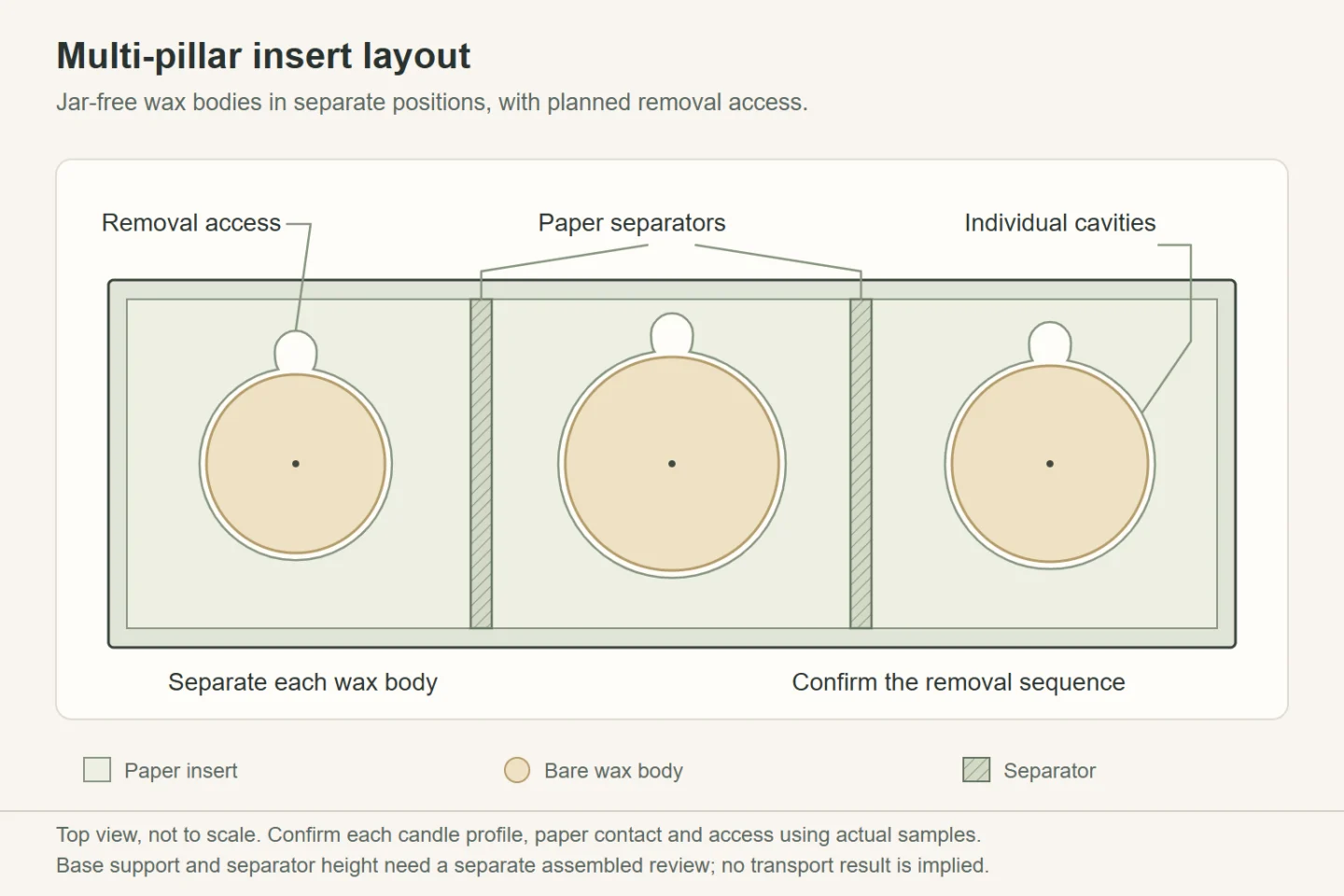
A multi-candle set needs a layout for each actual size. Give every pillar a defined position and review contact paths between wax bodies, wider decorations, accessories and dividers. Use separation that remains meaningful across the full profiles, not only at the narrowest section.
Continuous separators and individual openings can make the layout clear. Confirm their height, stability and supporting construction in the assembled sample. A top-view drawing shows positions; it cannot prove those hidden properties.
Review the removal sequence too. Staff should be able to load the set consistently, and lifting one candle should leave the remaining arrangement manageable. Confirm where fingers or an agreed access feature reach the product without dragging it across a rough edge.
Compare the box shape with the same candle
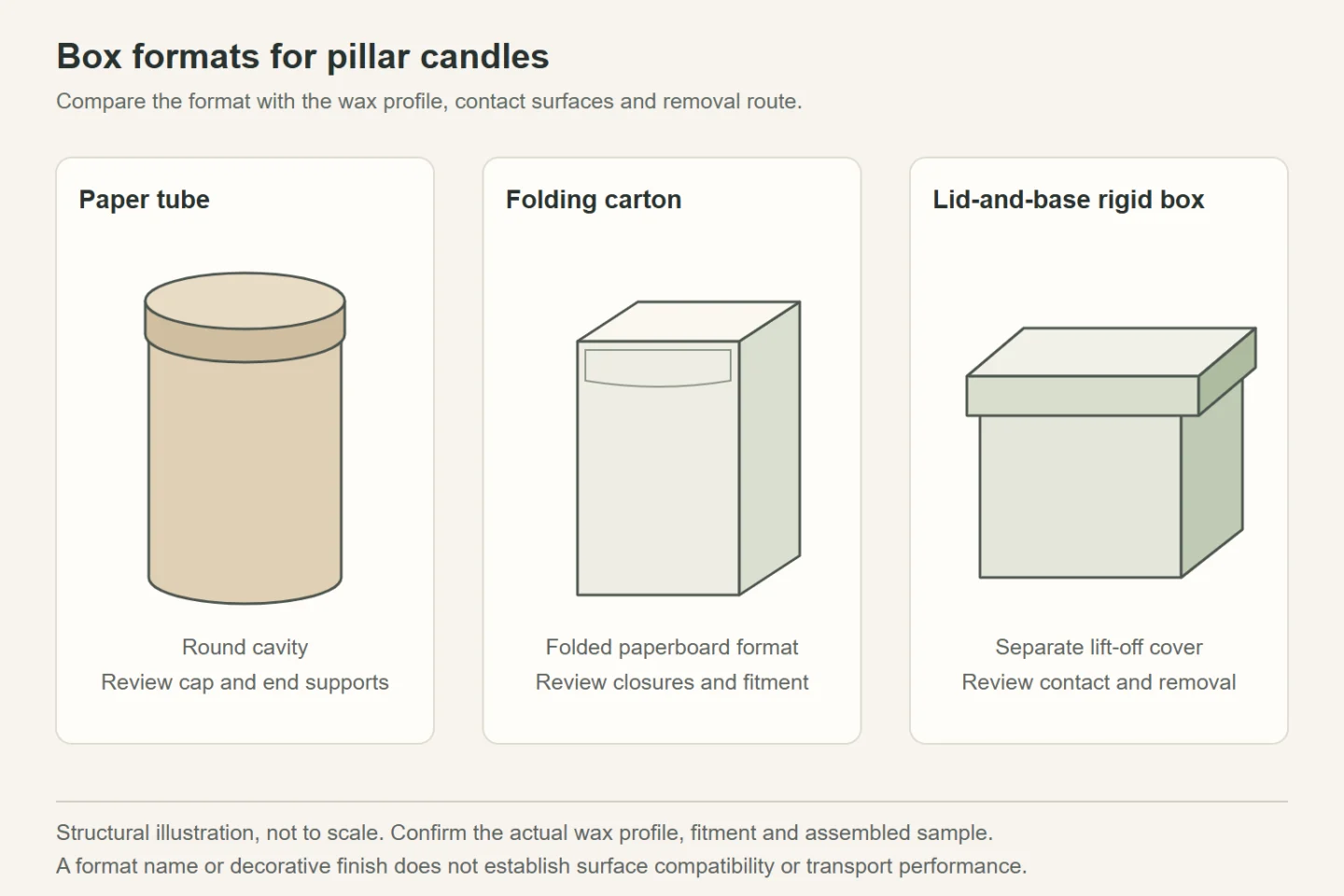
Compare cylinder candle packaging with rectangular pillar candle boxes using the same product and support requirements. This keeps the decision focused on fit, presentation and packing work.
| Format | A presentation to consider | Questions for the loaded sample |
|---|---|---|
| Paper tube | A round single pillar with wraparound graphics | Does the usable cavity accommodate supports, surface contact and wick space? |
| Folding carton | An individual retail candle or coordinated range | How are the base, closure and internal positioning assembled? |
| Rigid box | A gift pillar or an organized multi-piece set | Can each candle be loaded and removed while the lid or drawer works freely? |
A rectangular carton can provide a clear front panel and a defined loading direction. Discuss the bottom construction and insert together; a tuck closure name does not establish support for every candle.
A rigid box can frame a gift presentation, but its substantial appearance does not establish compatibility with bare wax. Review the inner contact surfaces and supplied format. Our Folding Cartons collection provides additional construction references.
Check the wax and contact material together
Confirm the actual candle formulation, surface treatment and decoration with the brand or candle manufacturer. Wax-family names do not describe every finished product’s behavior. For example, Cargill’s NatureWax portfolio lists grade-specific applications.
Review the proposed paper, liner, wrap or fitment against representative finished candles. Check what happens during the intended loading, closure, removal and handling sequence. Look for transferred color or residue, surface marking, sticking and changes to decorative edges.
Tissue or another liner can be evaluated as a contact layer, but its name alone does not prove that it prevents scratches or deformation. Identify the selected material and construction, then record what the sample represents.
Ask for the product’s relevant handling and storage conditions. A paper tube or rigid box is not automatically temperature control, and one successful fit review cannot establish performance in every environment.
Make gift presentation practical to open
Build the visual design around a workable product reveal. A selected paper wrap, restrained print system and one decorative detail can give the set a coherent identity without adding several unrelated components.
Compare printed graphics, selective foil or relief on the chosen outer paper. Approve the actual effect before extending it across the range.
Keep fragrance, size or set identification easy to find. If the wax color or texture is part of the presentation, assess a window or open reveal with the complete structure. Consider what the opening exposes and how customers reach the candle.
Review lid, drawer or sleeve action with the supports loaded. Decorative ribbons and cards should have a clear role and should not become an assumed support or wick-clearance solution. An attractive empty gift box still needs the actual candles for approval.

Review protective packaging for pillar candles on samples
Use a defined review before committing to a production specification:
- Record the candle profile, weight, finish, formulation reference and wick projection.
- Assemble the selected box and supports using the intended packing sequence.
- Load, close and remove the candle while checking base support and contact.
- Inspect the wax surface and any liner or decoration after the agreed handling review.
- Retain approved drawings, materials and physical references, including unresolved conditions.
A white sample helps assess the construction it represents. A printed or decorated reference may approve other properties, so identify any substitute stock or simulated finish.
Where transport protection is required, review the representative candle, supports, retail box and outer packing for the intended route. Our candle shipping guide covers that separate task. A fitted interior or closed tube is not a test result.
Review changes before substituting a new candle size, wax finish, contact material or closure. Keep the accepted configuration identifiable for repeat orders.
Frequently asked questions
How do you secure pillar candles without glass jars?
Define base support, suitable body contact and space around the top and wick. A folded platform, shaped locator or compartment can help position the candle when developed for its actual profile. Confirm loading and removal with the finished candle; do not use the wick as a handle.
Which box shapes work for pillar candles?
Paper tubes can follow a round presentation, folding cartons provide a rectangular retail format, and rigid boxes can organize gifts or sets. Choose by the actual candle shape, support, surface contact, opening and packing process. Sample the proposed construction before deciding.
Do pillar candles need inserts?
Use a fitment when the box needs additional positioning, support, separation or access control. The decision depends on the candle and complete construction. Do not assume every pillar needs the same insert, or that a close-fitting wall alone resolves its support and contact requirements.
Can one paper tube fit several pillar sizes?
Review each intended size before sharing a structure. Different heights, diameters, top details and finishes can change the cavity and support arrangement. Confirm cap clearance, location and removal for every approved configuration rather than relying on a shared fragrance range or product name.
Turn the idea into an approved pillar pack
Compare LUX BOX candle packaging options with the bare wax body, supporting arrangement and opening experience in mind. Keep the approved candle and packaging references together.
Contact LUX BOX with candle photos, dimensions, weight, surface details, set quantities and packaging requirements to discuss the structure and sampling scope.


