How to Package Taper Candles Safely
Plan support and separation for slender taper candles, then review long cartons, drawer packs and the complete shipping arrangement with the actual product.
Candle Type Guide
Design Concept Notice
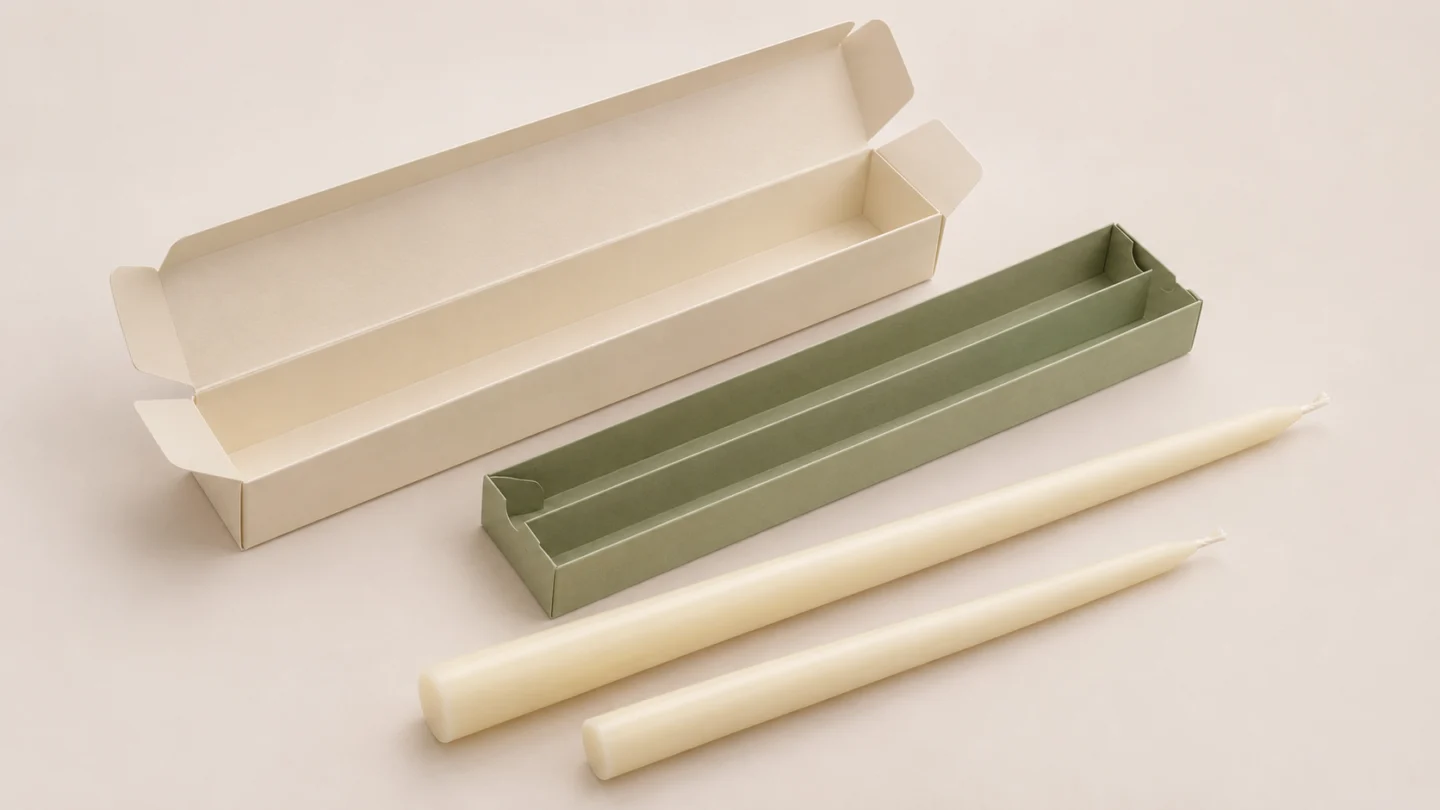
The product visuals in this article are AI-generated design concepts, while the structural drawings are illustrative schematics. None are photographs of LUX BOX client projects or approved production samples.
Knowing how to package taper candles starts with their long, changing profile. The box needs to accommodate the finished wax body, support it in the intended position and let someone remove it without pulling the wick or stressing the tip. A carton that looks proportionate on screen can still leave a long section unsupported or catch a decorative ridge during packing.
For candle brands comparing taper candle packaging ideas, treat the candle, insert and outer box as one development project. Paper packaging is not temperature control: a fitted support does not establish that every wax formulation will remain straight in every storage or shipping environment.
Why Taper Candles Need a Different Packing Plan
Tapers are slender candles intended for use in a holder. Their packaging brief differs from a glass jar or a broad, self-standing pillar: the exposed wax body, narrow upper end and long profile all need attention.
A straight dinner candle, a twisted taper and a stepped decorative candle may share a nominal base diameter but need different contact surfaces. Plan around the actual product rather than enlarging a generic candle cavity. Record whether the pack will lie flat, stand on a shelf or change orientation during fulfillment.
Measure the Whole Finished Profile
For long candle packaging, supply an actual finished candle where possible, supported by a dimensioned product drawing. Distinguish wax-body length from the additional space needed around the upper end and projecting wick.
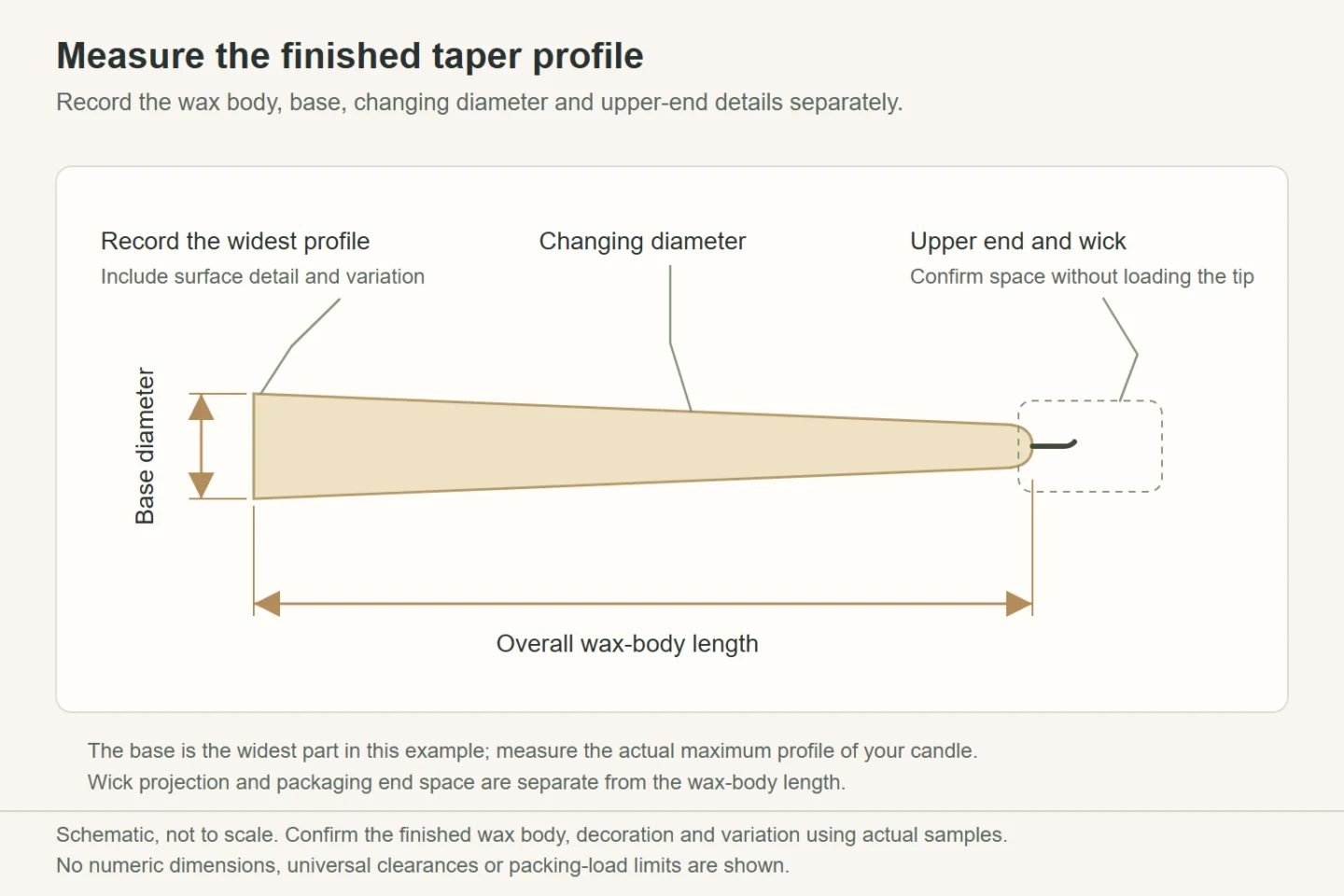
The measurement brief should include:
- Wax-body length, base shape and base diameter.
- Maximum outside profile, including twists, ribs and applied decoration.
- Diameter changes along the body, rather than one average diameter.
- Tip shape, wick position and any projecting feature.
- Actual weight, expected product variation and candles per box.
Include any wrap that stays on the candle during packing. The supplier must develop the usable interior after considering the insert, folds and closures; external box dimensions alone do not describe the available cavity. For the broader drawing and approval workflow, see our candle box packaging design guide.
Develop Taper Candle Box Inserts Around Support and Access
Separate four questions: what locates the candle, what supports its body, what limits movement and how it comes out. A channel can define a position without providing suitable support along the entire profile.
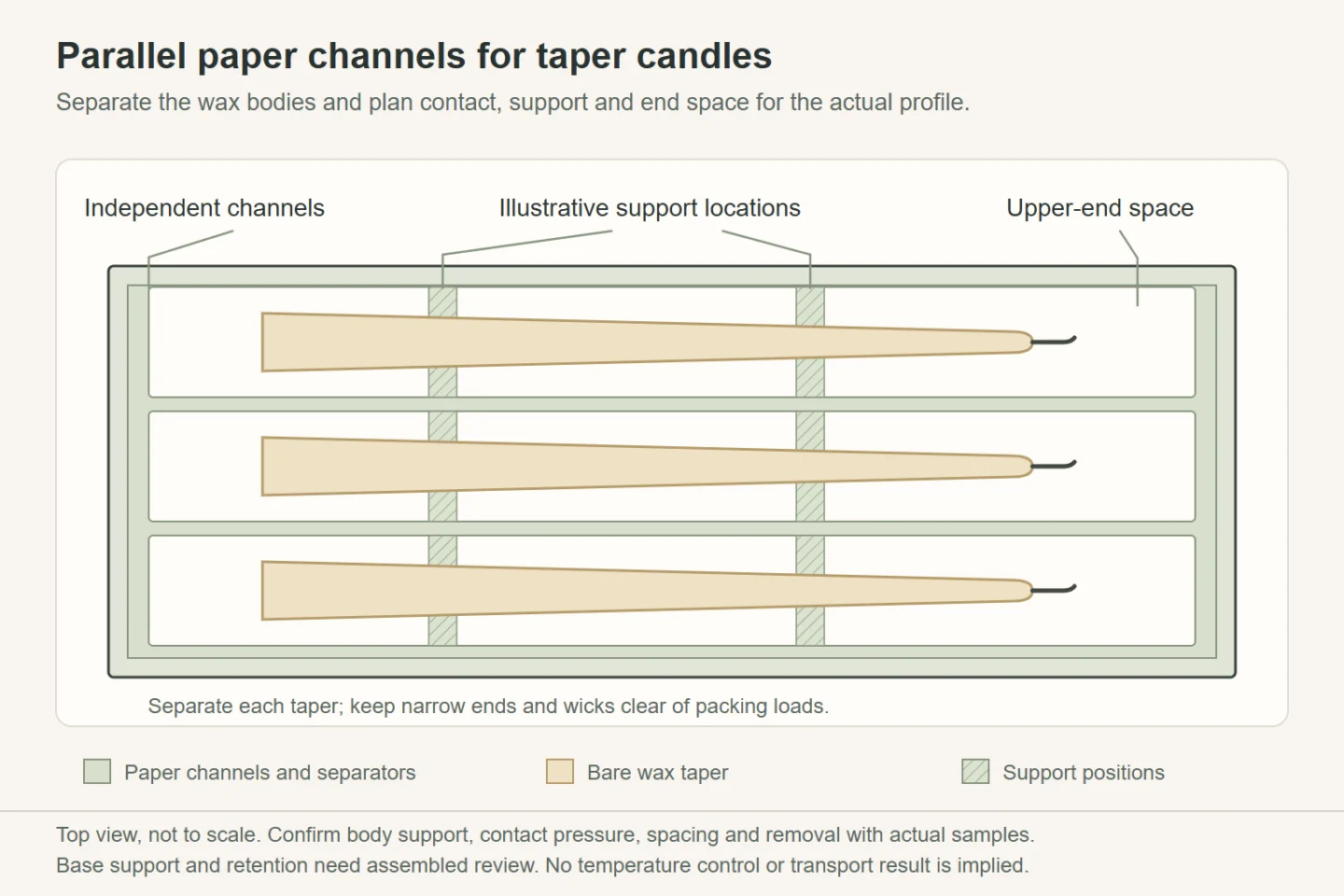
Review contact areas against the actual wax and geometry. A folded paperboard tray might use shaped channels or supporting features, but there is no universal number of supports or distance between them. Avoid treating the narrow tip or wick as a load-bearing point. End features should address lengthwise movement without pressing the candle into a fragile upper end.
Access matters just as much. A finger opening or accessible body section should allow removal without forcing wax past a tight cut edge. During sample review, load and remove the candle using the intended packing method, then inspect both the product and support for marks or distortion.
Compare Long Cartons, Sliding Trays and Gift Boxes
Slim candle packaging needs more than a narrow outline. Compare taper candle packaging options by their opening, internal arrangement and packing process.

| Format | Useful opening or presentation | Checks before approval |
|---|---|---|
| Long folding carton | Compact retail pack with an end or panel opening | Loading direction, long-panel behavior, closure engagement and access to the supported candle |
| Sleeve with sliding tray | Reveals a pair or set as the tray opens | Tray movement, insert retention, end space and whether opening disturbs the candles |
| Long lid-and-base box | Exposes the set from above after the lid is removed | Lid clearance, body access, insert fit and the complete packed weight |
Browse folding cartons for structural directions rather than selecting by appearance alone. A paper tube is another possible format, but its round wall does not automatically support a taper: review internal positioning, end features and how the long candle is withdrawn.
A rigid presentation box also needs an appropriate interior. Its substantial appearance is not evidence of a particular protection level.
Give Singles, Pairs and Sets Defined Positions
For a single taper, check both sideways movement and sliding along the box. For pairs or larger sets, develop individual positions and separation across the relevant candle profiles. Two candles that look separate at their bases may still touch at a twist, decorative feature or upper section.
Review the removal sequence with the actual assortment. Can the first candle be lifted without pushing its neighbor? Does the remaining set stay organized? If a holder or accessory shares the box, give it a separate location rather than allowing it to rest against the wax.
A top-view layout can explain the arrangement, but cannot establish separator height, underside support or retention when the pack changes orientation. Those details require the assembled sample.
Review Materials Where They Touch the Wax
Choose the outer board, insert and any liner together. Printed paperboard, corrugated components and wrapped rigid construction offer different design possibilities; the appropriate specification depends on the product, structure and intended handling.
Check proposed contact materials with the finished candle. Inspect for unacceptable rubbing, color transfer, sticking or impressions during the agreed sample review. Smooth-looking paper or a layer of tissue is not proof of compatibility with every wax finish.
Keep decorative printing and finishing decisions connected to the structure. Review folds, seams and insert edges before approving artwork. A printed sample can help assess appearance and contact, while a blank structural sample can answer earlier questions about loading, support and closure. Neither should be approved for a purpose it has not demonstrated.
Present the Set Without Crowding the Ends
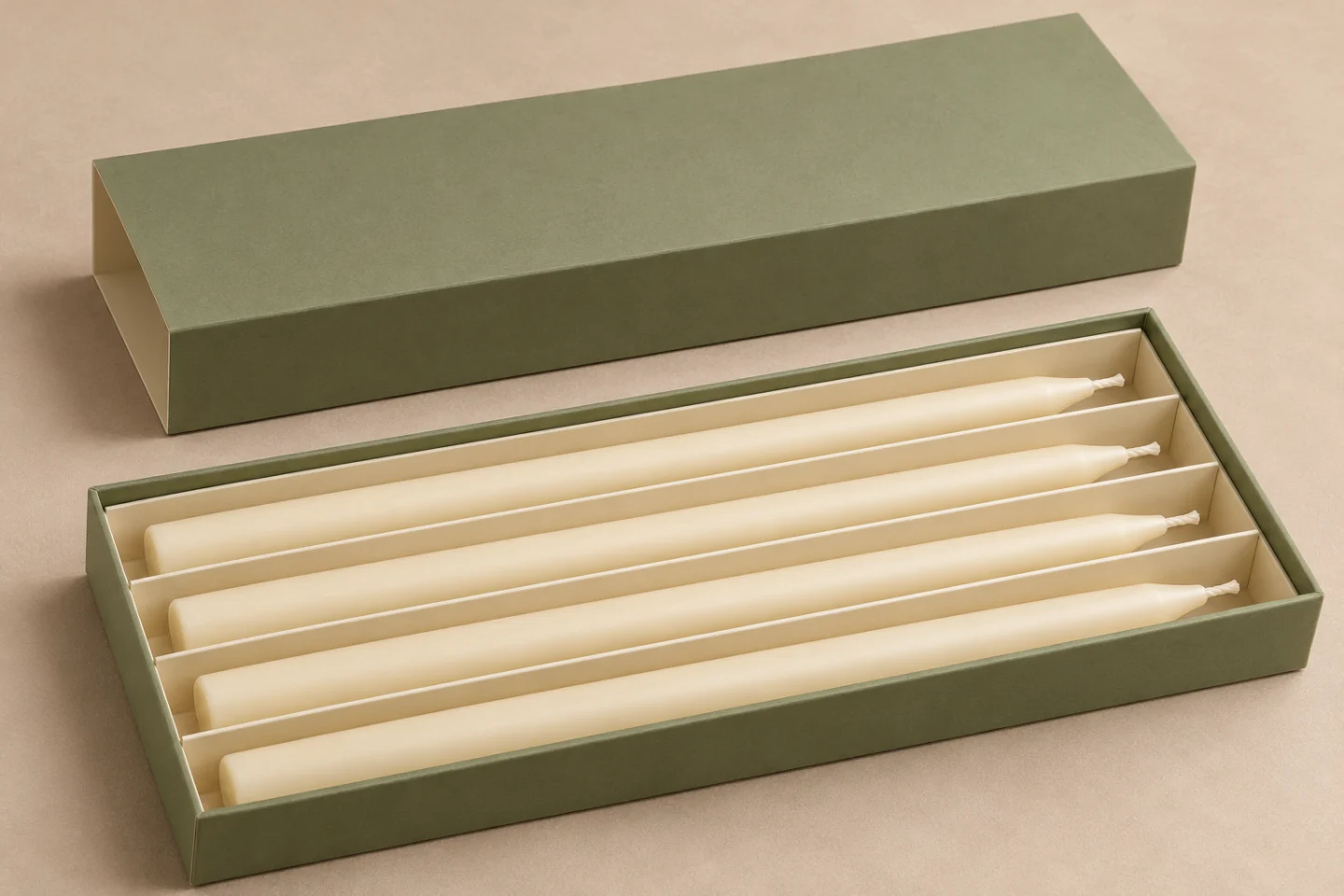
A taper gift set can use repeated channels and coordinated color placement to make the contents easy to understand. Preserve access to the candle bodies instead of filling every visible space with accessories or decoration.
Decide which surfaces should be visible when the box opens, then review the physical arrangement. Check that a card, ribbon or lid does not press against tips or wicks. Match the product count and variant information to the actual assortment.
Use our candle packaging collection to compare presentation directions, then develop the interior for your own candles.
Approve the Sample and Assess the Distribution Conditions
Before release, identify the approved candle version, insert, box material, closure and packing orientation. Record which sample demonstrates structure and which represents print or finish. Keep the approved references available for the packing team.
Assess the complete distribution pack separately where shipping is involved. The retail box, its internal supports, any outer carton and the actual candles work together. ISTA’s design and testing guidance explains why evaluation should relate to the distribution environment and representative product-package configuration. Define acceptable product condition before evaluating the pack.
Ask the candle manufacturer for relevant handling and storage conditions, then consider them against the intended route. Do not substitute a generic wax melting point for a finished-product shipping limit. Our guide to packaging candles for shipping covers the broader transport-pack discussion.
Frequently Asked Questions
How do you prevent taper candles from bending during shipping?
Develop support around the actual candle profile, limit unwanted movement and review end features without loading the tip or wick. Evaluate the complete pack under conditions relevant to the route. Support is only part of the answer: paper packaging is not temperature control, and no single insert can guarantee that every wax formulation will remain straight in every environment.
What carton structure fits long candles?
A long folding carton with a suitable internal support, a sleeve and tray, or a drawer-style box can be considered. Choose through sample review of the candle length, changing diameter, opening direction and packing process. An attractive long rectangle alone does not establish a workable fit.
Can two taper candles share one open compartment?
Review separate positions rather than assuming loose candles can sit together. Check contact paths along the full bodies, including decorative ridges, and consider what happens during opening and removal. A divider must be assessed with its support and retention features; a line on a layout is not sufficient evidence.
Does tissue paper replace a fitted support?
Tissue may be considered as a contact or presentation layer after compatibility review. It does not by itself define body support, prevent lengthwise sliding or control temperature. Confirm the function of each component with an assembled sample.
Prepare a Brief for Your Taper Candle Pack
Send the finished candle profile, actual samples, quantity per box, intended arrangement, packing orientation and distribution information. Add your artwork status, material preferences and the opening experience you want to achieve.
Contact LUX BOX to review the candle dimensions, proposed support, box structure and sample requirements together.