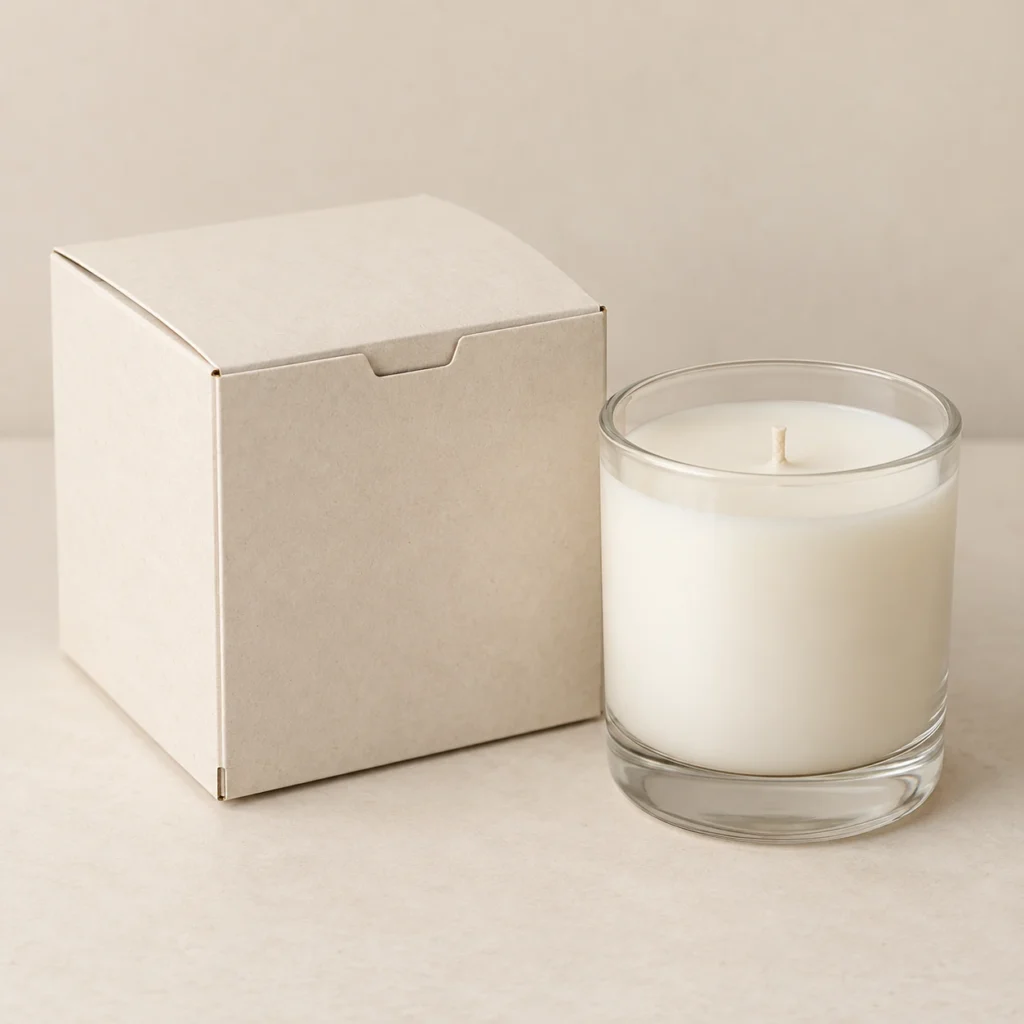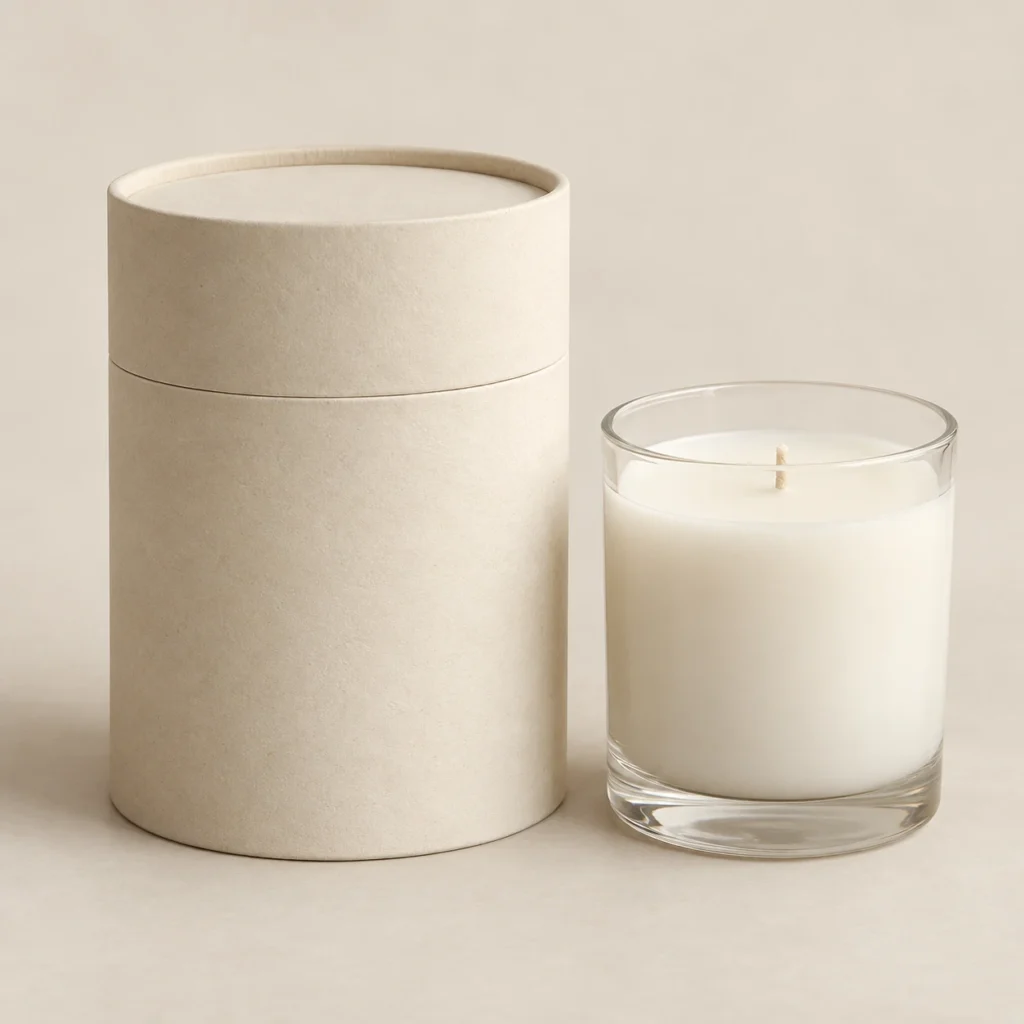
Candle Packaging Ideas for Premium Candle Brands
Explore eight candle packaging directions, from expressive cartons to discovery sets, and compare their visual purpose, structure and practical limitations.
The most useful candle packaging ideas connect a recognizable visual identity with a box that suits the candle and the way it is sold. A printed carton can give a core fragrance range a clear shelf presence. A fitted presentation box can turn a signature candle into a gift. A divided set can introduce several scents together. Choose the experience first, then develop the paper, structure and finish around it.
For premium brands, luxury candle packaging ideas should also answer practical questions: Can customers identify the scent? Can staff pack it consistently? Can the customer remove the jar comfortably? What happens when the range changes?
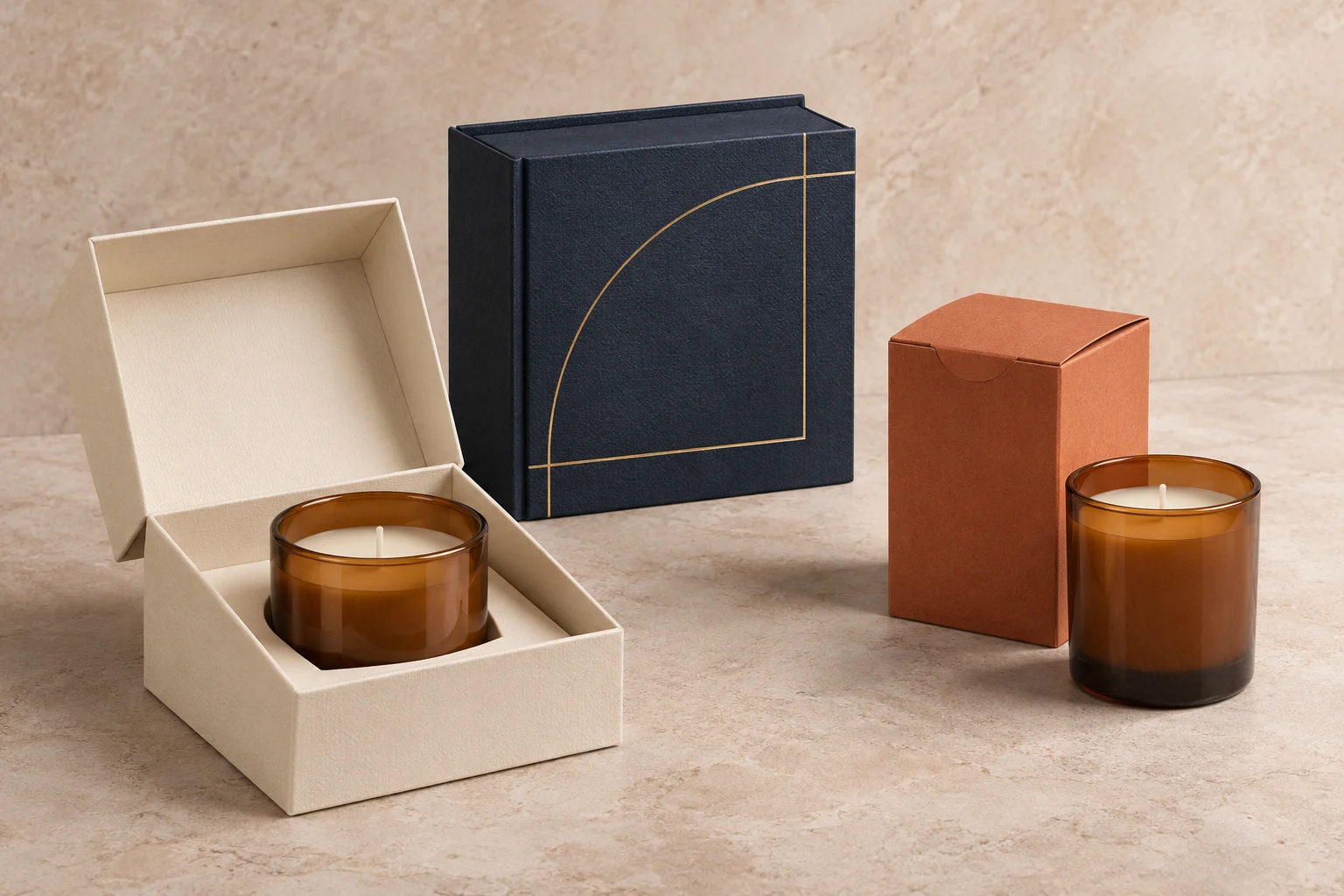
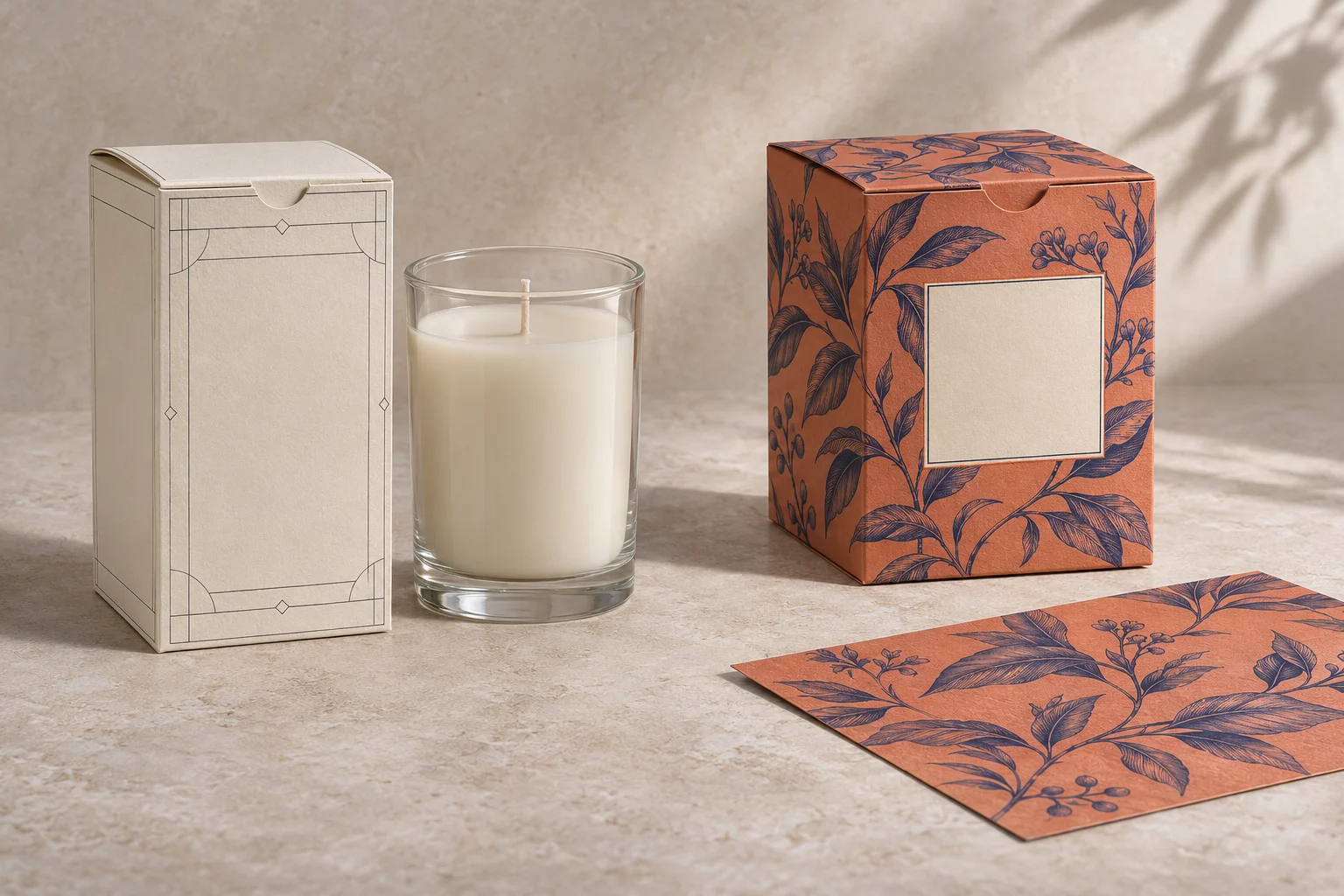
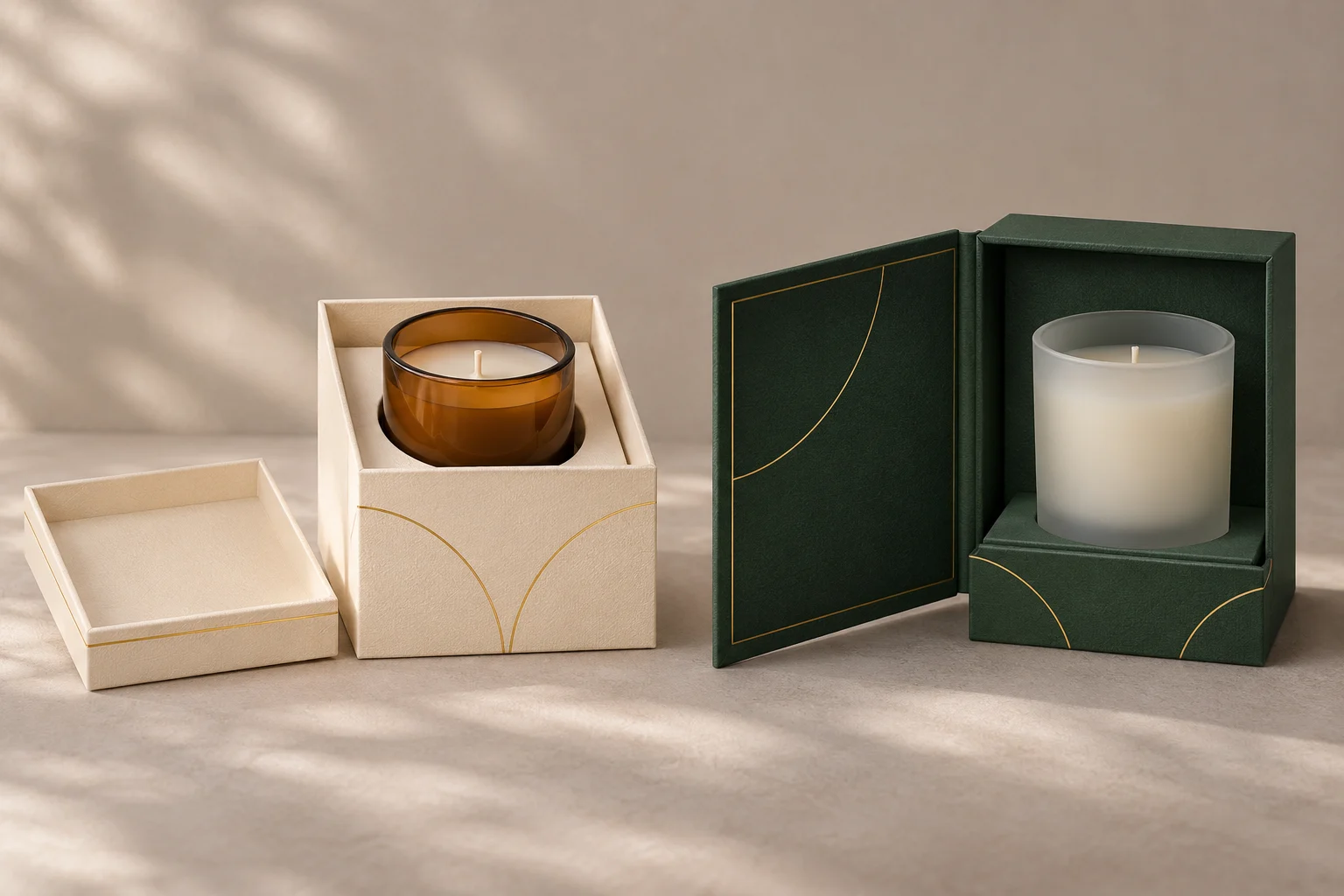
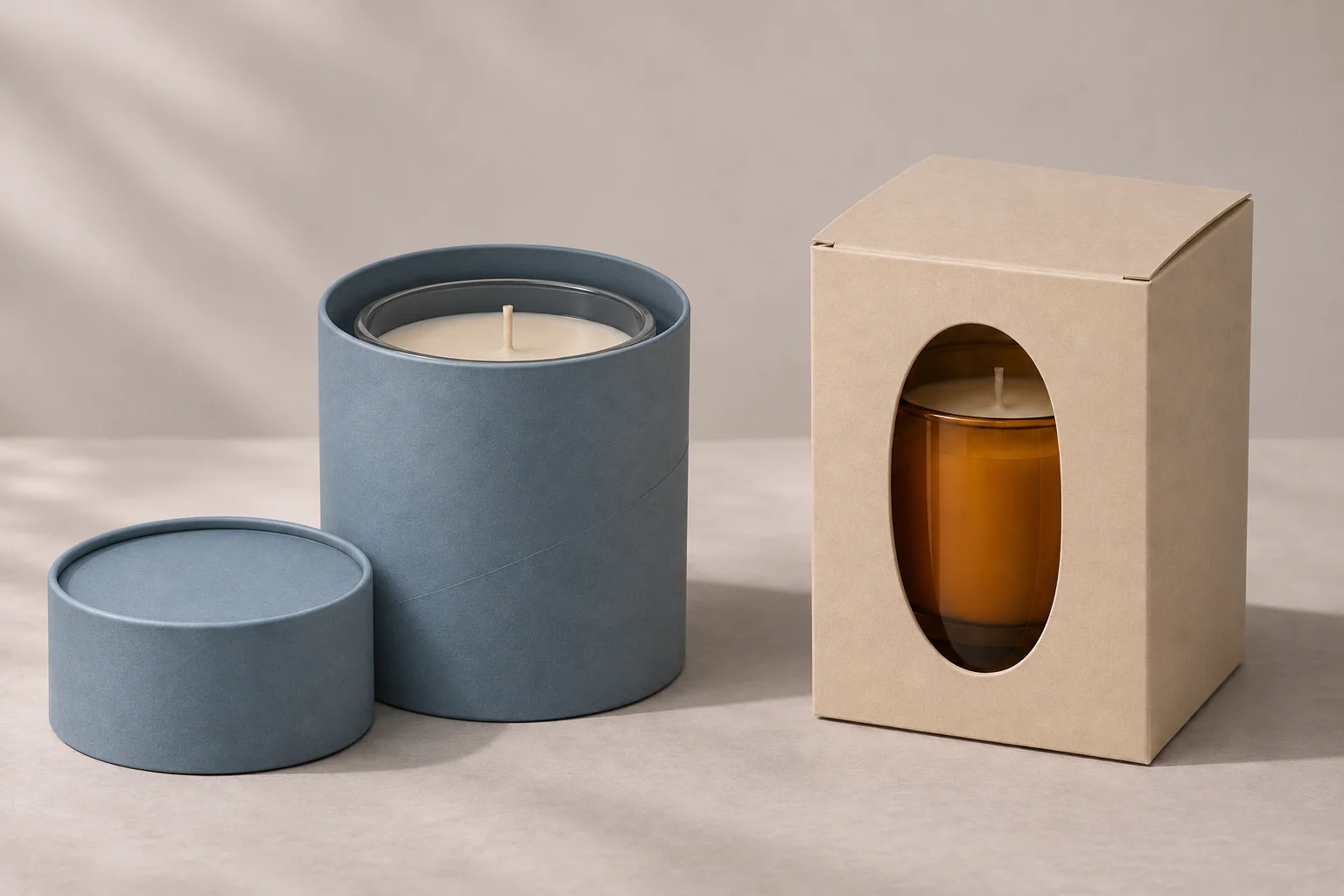
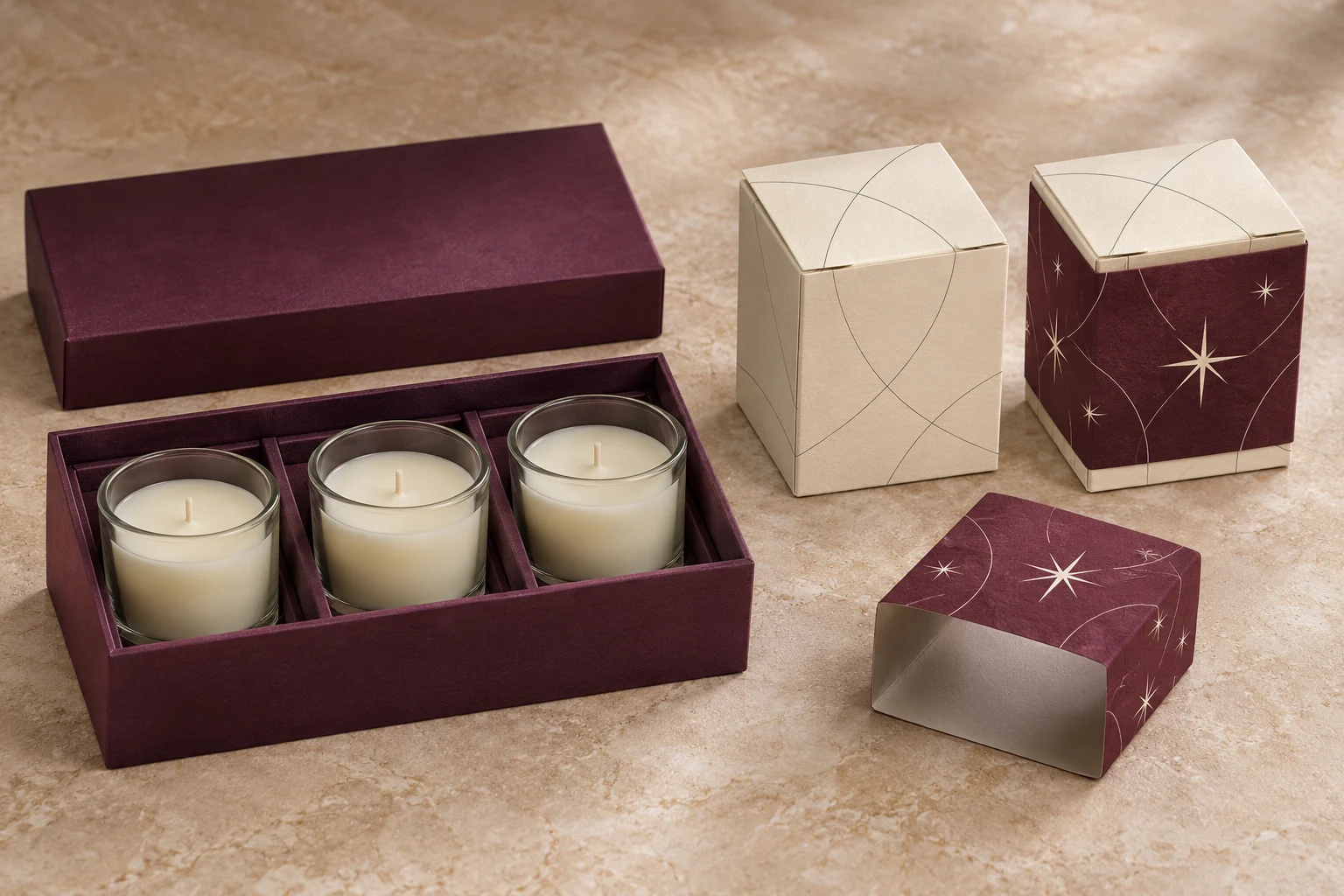
AI-generated design concepts illustrating different presentation directions. These are not LUX BOX client projects or evidence of protective performance.
Eight packaging directions worth exploring
These packaging ideas for candles focus on different design decisions, from shelf identity to the opening experience. The suggested materials and processes are starting points for discussion. Confirm each combination on the proposed stock and a physical sample.
1. Build a gallery-style carton around typography
Give a core collection a consistent front-panel grid: brand, fragrance, then supporting information. Generous margins and a controlled type hierarchy can make an everyday retail carton feel deliberate without adding multiple decorative components.
A square or rectangular folding carton is a useful starting point for jar candles sold individually. Consider an ivory or muted printed paperboard, with one accent color to distinguish scents. Reserve the remaining panels for the information your product and retail channel require.
This direction suits boutique brands and private-label ranges that need a recognizable family across several fragrances. Review the smallest text at actual size, and check that fragrance identification remains visible when cartons sit close together. A beautiful front panel will be less useful if packers need to turn every box around to find the variant.
Explore candle folding cartons once the visual hierarchy is clear.
2. Translate the fragrance story into original illustration
Let the artwork express a specific mood: architectural linework for an urban collection, abstract color fields for a contemporary range, or botanical drawings for a fragrance with a relevant plant story. Keep one clear area for the scent name so the illustration supports identification.
A printed folding carton provides several connected panels for this approach. Plan how the artwork crosses folds, where the seam falls and which face customers see first. A textured-looking illustration printed on smooth paper is a different choice from using physically textured paper.
This direction works for collections with distinct scent personalities or artist collaborations. Its main limitation is artwork management: new designs need controlled files and a consistent placement system. Depicting a plant should not imply a verified ingredient or sourcing claim unless that claim is true.
3. Frame a signature candle in a lid-and-base box
For a candle intended as a gift or a permanent hero product, consider a two-piece rigid box with a completely removable lid. Use the depth of the lid, the visible border around the jar and the interior color to create a composed reveal.
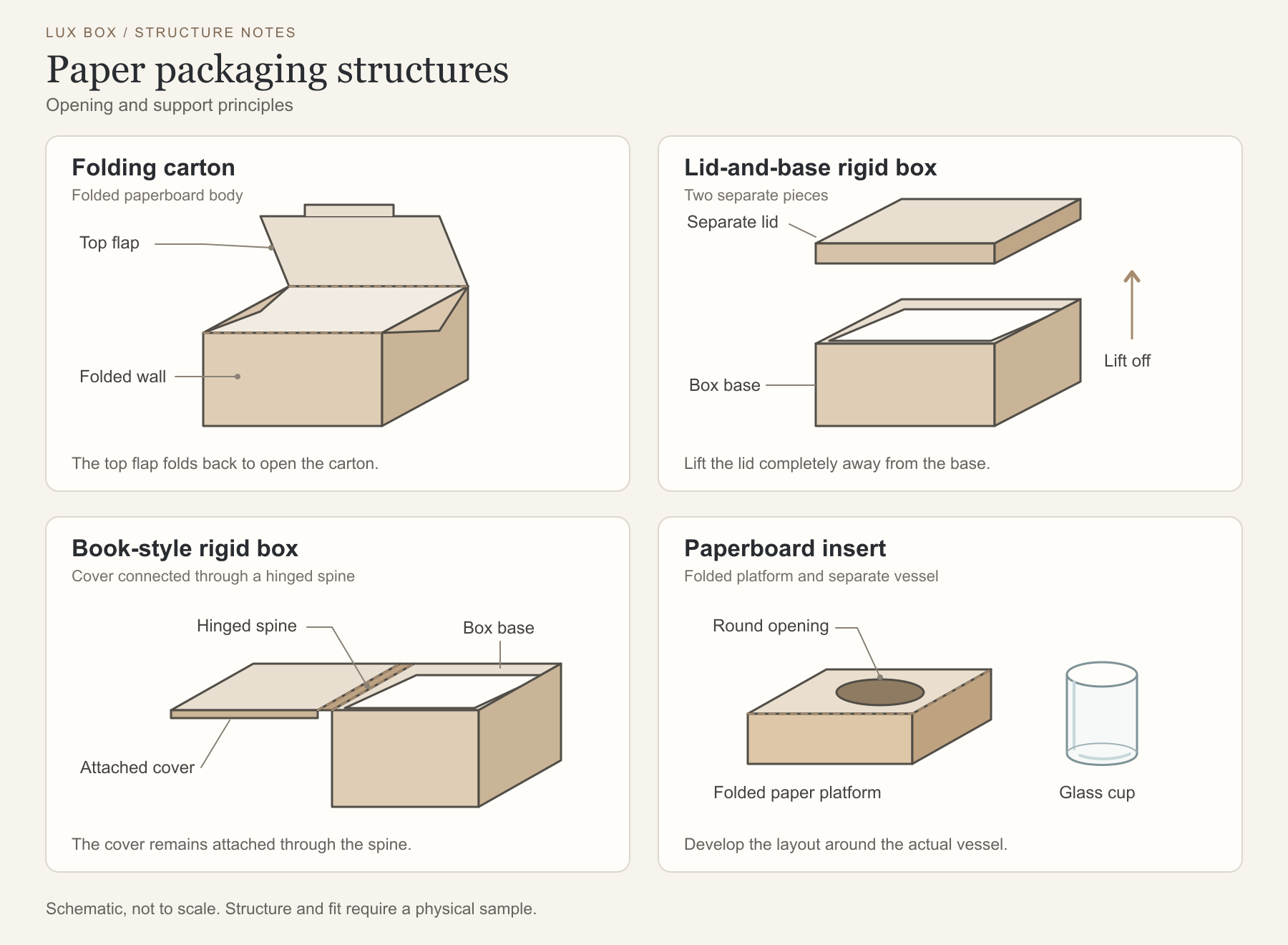
Discuss the structural board and the visible wrapping paper separately. A grayboard core and a selected paper wrap perform different design roles; the wrap determines the visible color and texture. A fitted paperboard platform can position the jar for presentation, subject to a structural review of the actual product.
Keep the jar easy to grasp. A deep recess may look dramatic but make removal awkward. Where the box is supplied already formed, compare its packed volume and storage needs with the alternatives. An attractive empty box does not establish how it performs with a filled candle.
4. Use a book-style opening to reveal a message or interior pattern
A hinged cover lets the inside of the lid become part of the experience. Put a short fragrance story, an original pattern or a clear gift message there while keeping the outside restrained.
A wrapped rigid book-style structure suits a signature gift, a launch edition or a coordinated set. Specify the hinge and closure as part of the structure. If considering a magnetic closure, ask how it will be incorporated and assessed in the proposed construction.
Give the interior content a purpose: help the recipient understand the fragrance or the collection. Review whether the cover stays comfortably open for product removal and whether any accessory needs its own space. Extra closure components and interior decoration also add items to the specification and approval process.
5. Echo a round vessel with a paper tube
A cylindrical silhouette can distinguish a candle collection from a row of rectangular cartons. Carry a band of color, a simple motif or a repeated graphic around the tube, then give the scent name one easily located reading position.
This direction suits round jar candles and visually coherent single-candle gifts. Discuss the tube body, wrapping paper, cap overlap and internal support as separate elements. Review paper tube packaging for candles to develop the structure further.
Check the complete candle with its lid in place. A round outside shape does not guarantee an appropriate inside fit. Also consider how the tube sits in a retail display, how the cap is removed and how its cylindrical form fits into the outer shipping arrangement.
6. Make the vessel part of the design with a controlled window
If the jar itself carries a distinctive color or decoration, a small die-cut opening can frame that feature instead of reproducing it on the carton. Keep enough surrounding board for the proposed structure and leave a clear, uninterrupted information panel.
A folding carton is a starting point. Decide whether the window will be open or use a separate film component; these are different specifications. The concept shown here uses an open window.
This idea suits retail presentation where customers benefit from seeing the vessel. It is less attractive when the opening exposes a surface that must stay clean, interrupts important information or creates a weak area in the proposed carton. Confirm the cut-out with the jar and internal support in place. A window is a display decision, not a substitute for transit packaging.
7. Turn a discovery set into a readable fragrance collection
Use a shared box to introduce several smaller candles as a sequence: an everyday selection, a fragrance family or a curated gift. Keep the identifying information in the same place for each scent so customers can compare the range at a glance.
A shallow lid-and-base box or a hinged box can organize the set. Separate paperboard pockets give each candle a defined position in the layout. The image shows a three-candle concept, not a standard set size.
Plan the removal sequence before adding decorative cards or accessories. Can someone lift the first candle without tipping another? Can staff distinguish the scents after the box is packed? Review the jar shapes and the complete loaded set when developing paperboard inserts. An orderly presentation alone does not prove cushioning or shipping protection.
8. Refresh a core pack with a seasonal sleeve
A removable paper sleeve can give an established carton a limited-edition identity while keeping the underlying structure familiar. Use a different illustration, a gift message or a seasonal color arrangement rather than redesigning every component.
This is useful when the finished candle, base carton and loading method remain unchanged. Develop the sleeve over the actual packed carton, with enough consideration for sliding it on, keeping it aligned and removing it without damage.
Compare the extra packing step with the value of the seasonal presentation. The sleeve must not obscure information that needs to remain visible. If the jar or carton changes, check the sleeve again; a shared fragrance family does not automatically mean shared dimensions. This is a way to explore unique candle packaging ideas without treating every launch as an entirely new structure, not a guaranteed cost-saving method.
Compare three briefs for the same candle
To narrow down candle box packaging ideas, keep the product input fixed and change the selling task. The following is a hypothetical planning example: one finished glass candle, with its lid, used across several fragrances. It is not a LUX BOX customer project or quotation.
| Design brief | Direction to compare | What stays consistent | What needs a separate decision |
|---|---|---|---|
| Boutique retail replenishment | Gallery-style or illustrated folding carton | Finished jar, front-panel hierarchy and fragrance naming | Carton closure, print variants and packing sequence |
| Gift presentation | Lid-and-base or book-style rigid box | The same finished candle and brand identity | Wrap, fitment, opening experience, removal space and supplied box volume |
| Seasonal direct-to-consumer order | Core retail carton with a seasonal sleeve, inside an assessed shipping pack | The core candle and retail carton, if unchanged | Sleeve fit, extra assembly and the complete parcel packaging arrangement |
Choose two directions for sampling rather than asking a supplier to quote every visible treatment at once. Within the chosen brief, compare the two directions using the same filled candle, information requirements and sales channel. This makes differences in the samples easier to interpret.
Match the paper and finish to the design
Separate the choices that create the structure from those that create its visible surface. In a folding carton, the selected paperboard is cut and creased to form the box. In a wrapped rigid box, the structural board and visible wrap are separate specifications, as illustrated in KOLBUS's box-making system overview.
When comparing paperboard and cardstock options, specify the desired surface, artwork and structure together. A paper's color, texture or name cannot establish the finished pack's protective performance. A natural-looking surface also does not establish a recycling or certification claim.
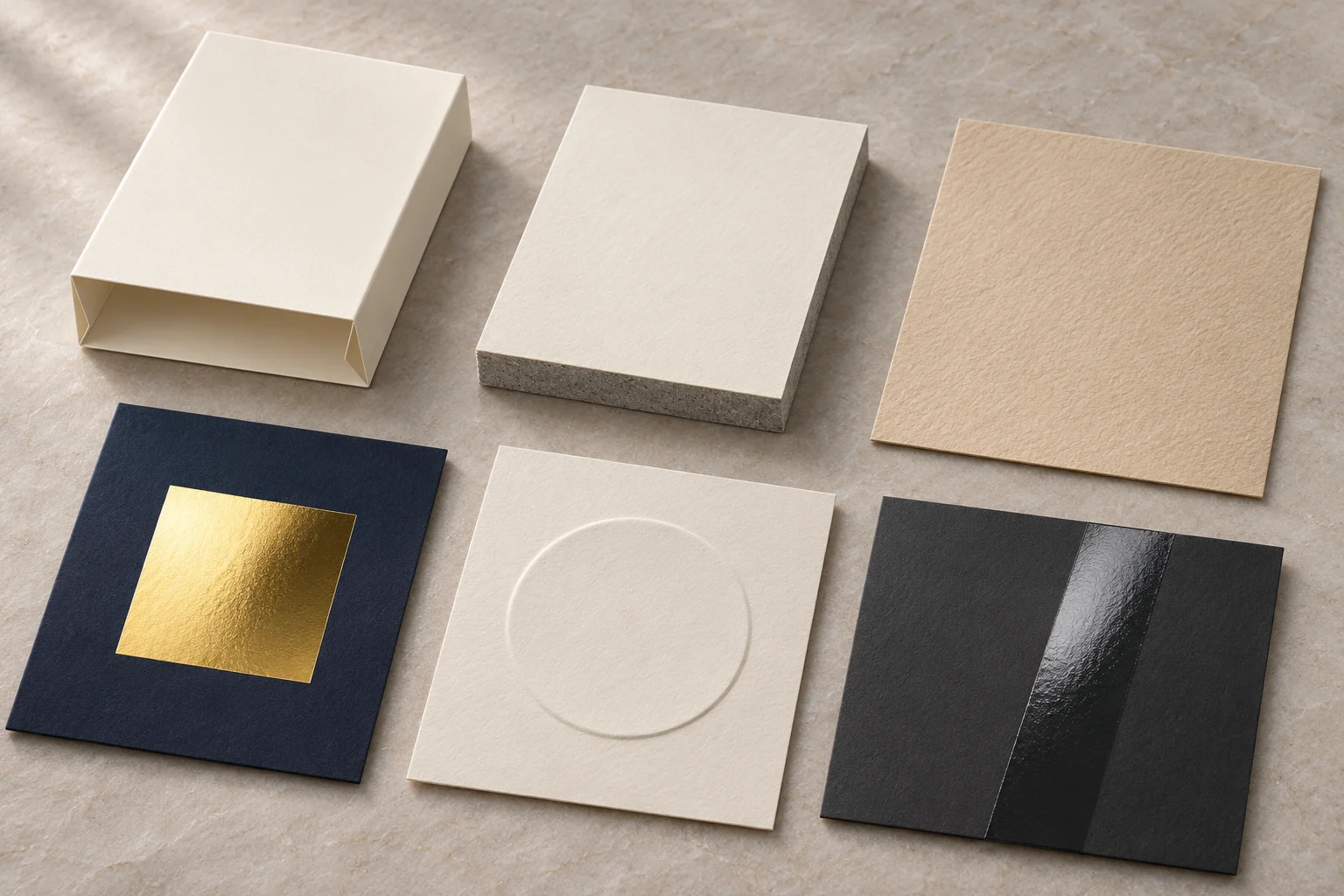
Use printing and decoration with a clear purpose
Printed artwork establishes the color system and fragrance identity. Discuss the proposed printing method, including offset printing where appropriate, with the supplier, and request a proof on the chosen stock. Offset printing transfers the image through a rubber blanket before it reaches the paperboard, as described in Iggesund's Graphics Handbook. The printed result still needs to be reviewed with the intended paper and finishing sequence.
Choose a primary decorative effect that contributes something specific:
| Treatment | Design role | What to review on the proposed sample |
|---|---|---|
| Hot foil stamping | A reflective detail on a mark, line or small focal area | Foil coverage, fine-detail reproduction and the selected paper surface |
| Blind embossing or debossing | A raised or recessed feature without relying on another printed color | Legibility, paper response, artwork detail and placement |
| Matte or gloss film lamination | A different surface appearance over the printed sheet | The actual film, adhesive, ink and compatibility with later decoration |
| Textured paper or wrap | Tactile character across a larger area | How the texture affects print, lettering and the intended decoration |
Hot foil stamping uses a heated die and pressure to transfer a foil layer; embossing and debossing form raised and recessed details. These are distinct from simply printing a gold color. Iggesund's printing and converting manual explains why artwork, tooling and paperboard must be considered together.
If combining lamination and foil, review the complete combination. Holmen's lamination guidance identifies compatibility considerations across films, adhesives and subsequent decoration. Neither a finish name nor a digital rendering guarantees a particular result. For a metallic focal detail, review foil stamping on the selected paper rather than approving the effect from a screen alone.
Give the shortlisted ideas a practical sample brief
Creative candle packaging ideas become easier to evaluate when the sample brief names the experience you want and the conditions it must work within. Include:
- The finished candle with its lid, plus measured dimensions, filled weight and relevant vessel variations.
- The intended channel: individual retail sale, gifting, a discovery set or parcel delivery.
- The two shortlisted design directions, the visual identity to preserve and the surfaces that need to carry product information.
- The proposed paper or wrap, printing, decorative effects and insert layout, with priorities identified if trade-offs are needed.
- Estimated units per fragrance or SKU, who will pack the candles, where packing takes place and what may change in future editions.
- Sample checks: opening, loading, removal, scent identification, surface appearance and the complete shipping configuration where applicable.
Paper inserts can be cut, folded or layered around a product layout, as described in Smurfit Westrock's cardboard-insert guide. The appropriate support still depends on the actual candle and complete pack.
Keep gift presentation and parcel packaging as separate decisions. FedEx's general packaging guidelines distinguish gift boxes from shipping containers and discuss cushioning and movement control. Assess the filled candle, internal support, retail box and outer packaging together for the intended route; none of the concepts above is a tested shipping specification.
Once you have a shortlist, explore LUX BOX's Candle Packaging collection to connect your preferred direction with relevant structures and project-specific sampling discussions. Share the concept alongside the practical brief so the quotation addresses the whole pack, not just a similar-looking box.
Frequently asked questions
What packaging ideas make candle brands look premium?
A consistent relationship between the vessel, typography, paper surface and opening experience gives the design a clear identity. A restrained folding carton can suit an everyday premium range; a fitted rigid presentation box can suit a gift-led product. Choose details that serve that identity, then check their execution on a physical sample. More decoration is not automatically a better fit.
How can candle packaging stand out on a shelf?
Choose one recognizable signal: an original illustration, a distinctive silhouette, a controlled color system or a strong type hierarchy. Then test the front panel in the intended display context, with nearby products and realistic spacing. Keep the fragrance name readable and consistent across the range. A subtle tactile effect may contribute more in hand than from across an aisle.
What box styles suit candle collections?
Folding cartons can organize individual retail fragrances, lid-and-base and book-style boxes can create gift presentations, and divided set boxes can introduce several candles together. Paper tubes offer a different silhouette for round vessels. Select the structure around the finished products, desired opening sequence, packing method and channel. Different shapes and sizes still need individual fit checks.